How It Works
- You hold a position on one side of a market.
- You buy the other side with a market or limit order.
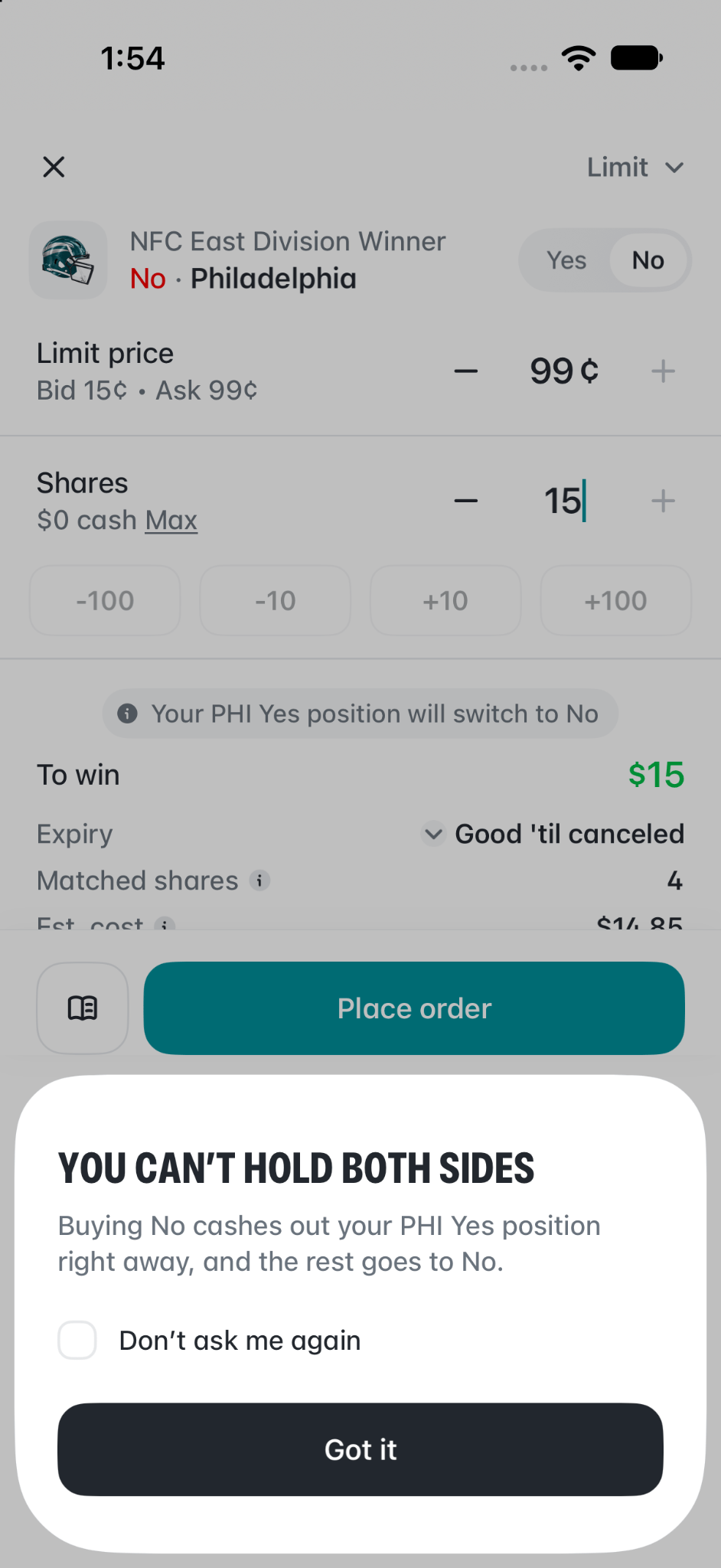
- Before the order goes out, a confirmation message in the app explains that this buy cashes out the position you hold.
- When the order fills, the matching part of your position is cashed out and the cash goes to your balance.
- Whatever is left is your new position. Your new position = contracts held − contracts bought on the other side (a negative result means you now hold the other side).
- Reduces: You buy fewer contracts on the other side than you hold. Part of your position is cashed out, and the rest stays open.
- Closes: You buy the same number of contracts on the other side as you hold. Your whole position is cashed out.
- Switches sides: You buy more contracts of the other side than you hold. Your whole position is cashed out, and the rest opens a position on the other side.
Examples
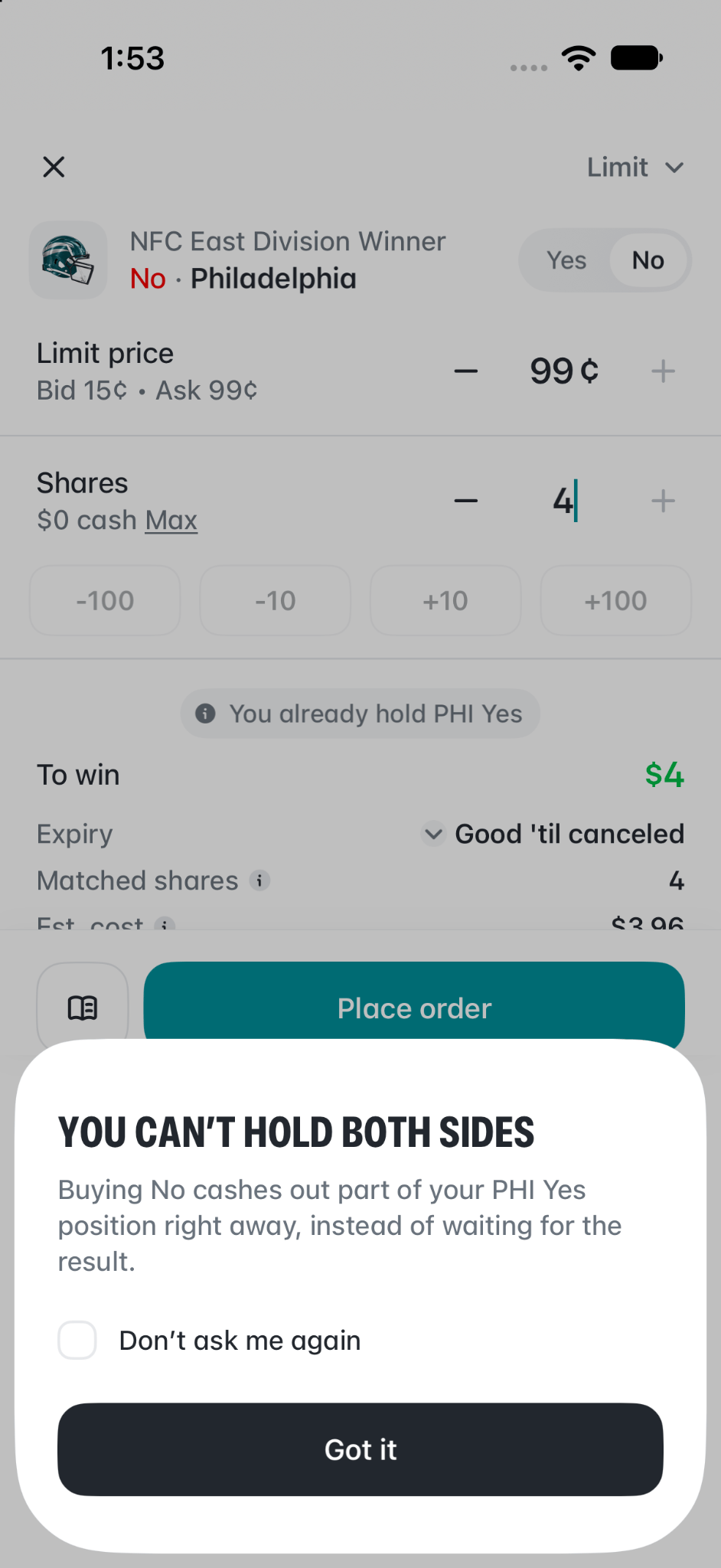
You hold 10 Yes contracts in a binary market (purchased at $0.60) Scenario A - Position Reduces- You buy 4 No contracts: 4 of your Yes contracts are cashed out. You now hold 6 Yes contracts.
- Math: At $0.25 per No, 4 × ($1.00 − $0.25) = $3.00 cash out.
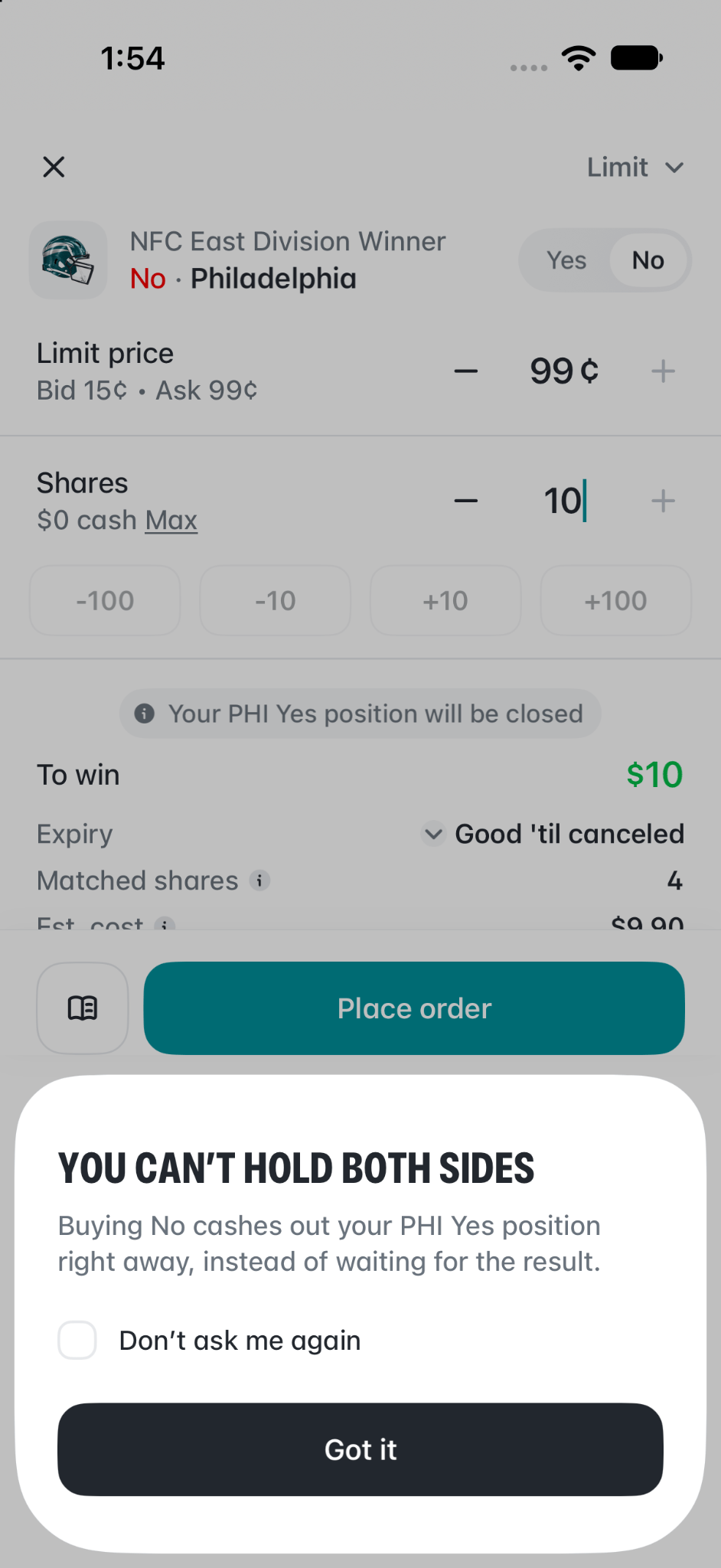
- You buy 10 No contracts: All 10 Yes contracts are cashed out. You no longer hold a position in this market.
- Math: At $0.25 per No, 10 × ($1.00 − $0.25) = $7.50 cash out.
- You buy 15 No contracts: All 10 Yes contracts are cashed out, and the remaining 5 go to No. You now hold 5 No.
- Math: At $0.25 per No, 10 × ($1.00 − $0.25) = $7.50 cash out, and 5 × $0.25 = $1.25 buys your 5 No. If the market resolves No then the payout would be $5.00.